Recent news came out about possible ratification of a 14-team playoff starting in 2026 after the two years upcoming with 12 teams in the CFP. While >12 teams is not yet official, 12 is the supposed minimum.
As it stands now, to me, the 12-team CFP does not create enough parity in college football, where part of this is the product of today’s landscape along with the lack of non-power-5 representation. I mentioned in my 2023 season farewell post that the NFL model would be more equal to all the conferences at the FBS level as the NFL model has division champs being allowed to host a playoff game, along with how I imagine a 5 or 6-team playoff would have been like amidst the expansion to 12 and then ultimately 14 teams.
The current 12-team model in CFP would have the top 4 conference champions getting first-round byes, and including the top Group of 5 (non-power-5) champion, as the Pac-12 is defunct and this leaves 7 at-large spots for teams ranked 5 to 11 in the final CFP rankings provided the Group of 5 representative is ranked outside the top 11. The team ranked no.12 would be the last team in if the Group of 5 team is ranked inside the top 11, and it would hence still be possible that the fifth of these 5 conference champions would miss the playoff if it is not ranked high enough. Retroactively applying this, I’ll use 2023, 2021, and 2012 as examples.
In 2023:
Top 4 conference champions who earn byes are: Michigan, Washington, Texas, Alabama. Top Group of 5 champion: Liberty. Teams 5 to 11 (in order) are: Florida State, Georgia, Ohio State, Oregon, Missouri, Penn State, Ole Miss. This would have left Oklahoma out at no.12 and Florida State would face Liberty in the first round, and Georgia and Ohio State each have rematches with teams they beat earlier in the season. Oregon faces Missouri.
In 2021:
Top 4 conference champions who earn byes are: Alabama (1), Michigan (2), Cincinnati (4), Baylor (7). The next highest power 5 champion was Pittsburgh, and they still would have gotten in because all of the power-5 champions being ranked inside the top 12 (Utah is the other one at 11). Georgia was the top team who didn’t win a conference so Georgia would have played Pittsburgh to open the first round, followed by Notre Dame playing Utah, leaving Ohio State to rematch against a team they beat by 49 (Michigan State), and Ole Miss would have played Oklahoma State in a rematch from the 2016 Sugar Bowl when the Rebels won by 28 points. It would very much have been possible that Georgia does NOT win the national championship in 2021 if the 12-team playoff were already in existence.
In 2012:
Top 4 conference champions who earn byes are: Alabama (2), Kansas State (5), Stanford (6), Florida State (12). The group of 5 representative would have been Northern Illinois (15). Louisville (21) and Northern Illinois both got BCS bids that season but Northern Illinois gets this node due to being ranked higher. You’ll notice the lack of presentation in the Big Ten here because Wisconsin won the Big Ten as an unranked team with Penn State and Ohio State being postseason ineligible. This would have left the other 7 teams being: Notre Dame (1), Florida (3), Oregon (4), Georgia (7), LSU (8), Texas A&M (9), Oklahoma (11). Notre Dame would have played Northern Illinois, Florida plays Oklahoma, Oregon plays Texas A&M, and Georgia would have played LSU. This would have been interesting if it was in play at the time, as an undefeated no.1 Notre Dame would not have earned a first round bye. Such a situation would have repeated itself in both 2018 and 2020 as Notre Dame’s final rankings before bowl season were 3 and 4 respectively.
Having said all of this, I wished to have seen discussion around including more than just 1 group of 5 team, such as allowing the four best group of 5 teams to be in, and have the other 10 of the 14 CFP teams in the 14-team model be from the Power-5 to increase the parity in college football. This would have been more feasible if there were still 5 power conferences. as the math of having possibly two teams per power 5 conference would have been easier. But with more teams entering the remaining power 4 conferences, there isn’t as much incentive, to me, to even out the representation in terms of the ratio of power teams to non-power teams. BYU and Cincinnati both entered the Big 12 last season so with Cincinnati having qualified for the 4-team CFP before, they’re now trying to give themselves as much of an opportunity as the teams they had to compete so hard against to get through that door.
For what it’s worth, In the 10 years of the 4-team CFP, 7 teams got in without winning a conference title, and only two of them won the national championship after qualifying under that scenario. The other five teams were a combined 1-5 with TCU being the only winner against Michigan in 2022, and the losses were by a combined 134 points, with the largest being 58 in the championship between TCU and Georgia. This to me is why conference championships, especially in the power 5, have mattered. Aside from Alabama in 2017 and Georgia in 2021, the other 8 CFP champs in the 4-team format won their conference before winning the national championship, and each of the 10 championship games featured a conference champion. 7 of those 8 CFP champs who won their conference beat another power 5 conference champion in the championship game. In total, only 15 different schools got into the CFP during those 10 years. Keep in mind that if the same teams made the playoff every year, there would have at a minimum been 10 schools that made it. At a maximum there would have been 40 if a different school made it in every year.
What I do like about this expanded playoff is for more schools to potentially get the chance to crash the party. 8 of the 15 schools that ever made the 4-team CFP qualified at least two times. The other 7 that made it once are Oregon, Florida State, Michigan State, LSU, Cincinnati, TCU, and Texas. As March Madness is around the corner too, perhaps we’ll have some 5-12 upsets in the upcoming years!
What I do not know is how the format of the 14-team playoff would be, or what the representation is. I imagine that Notre Dame is an impactful entity in this process as an independent because Notre Dame has finished in the CFP rankings inside the top 14 during 5 of the 10 years so far. But that shouldn’t mean they are entitled to a playoff spot. Teams that made the playoff multiple times did so because their teams were good enough to accomplish it. Same goes for the Irish, as they made it twice. Notre Dame’s respective finishes are NR, 8, NR, 14, 3, 15, 4, 5, 21, 16 (in the last 10 years), so if there were 12 teams, they would have made the playoff four times instead of the two they did qualify for. The graphic below has the final ranking for each of the 15 schools that made the 4-team CFP.
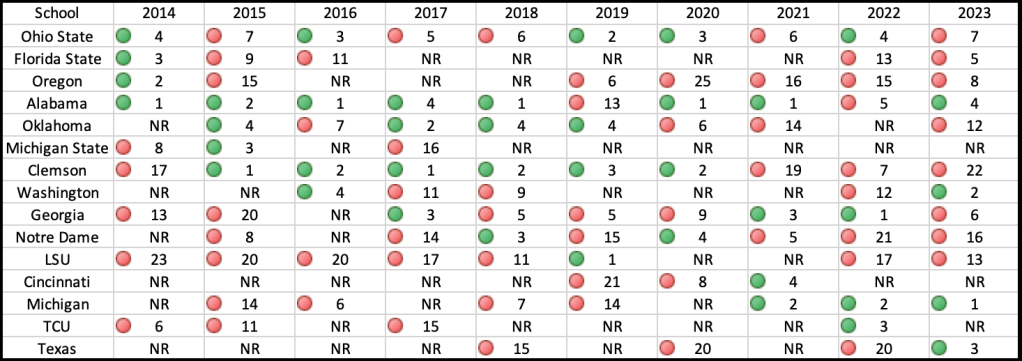
The green dots indicate the team made the playoff that season, red or NR means they missed. Alabama had the most appearances with 8, and Clemson was next with 6. While Alabama has hired Kalen DeBoer to follow the footsteps of Nick Saban, the other side of the expansion is that Alabama could drop off compared to past seasons and still have a chance to win a championship. Washington’s teams under DeBoer knew how to get hot at the end of the season and they did that en route to an Alamo Bowl title and a Sugar Bowl title.
While it is still to be determined from my knowledge, the ideal format I’d like to see is that the two best Group of 5 teams plus 12 power teams, where Notre Dame is included as a ‘power team’ even though they are an independent. In the current, yet evolving landscape of college football with NIL, NIL is only good for the sport if everyone at every level can get a piece of the pie. Right now, the pie pieces are much bigger for an Alabama or a Clemson than they would be for a North Dakota State or Montana, not to forget the Division I-AA level (FCS) also has 20 fewer scholarships per school as opposed to 85 at the FBS (I-A) level.
Again, because the team that made the CFP as a group of 5 team (Cincinnati and UCF) have both moved to the Big 12, the Group of 5 representation is a bit less competitive now than it could have been had schools like UCF and Cincinnati held off on moving to the Big 12 before the 12-team playoff had been played for the first time. To me, the obvious reason for the move is financially motivated, so Cincinnati and UCF are some of the many schools aware of the need to be financially competitive in NIL to match the competitiveness on the football field. Until this truly evens the playing field at all, NIL will still be problematic as it is complained to be.
Having said that, however, if there were two group of 5 teams and 12 power teams to make a 14-team CFP, here is what it would have looked like each of the last 10 years. With help from the college poll archive, I tried to take a crack at what the second Group of 5 team would be.

With the G5 representation, either both or one of the teams ranked 13 and 14 in each year would be the first to be eliminated. The first team to be eliminated from 2014 to 2023 if there were 14 teams under this proposal would be: UCLA, Michigan, Auburn, Notre Dame, Kentucky, Michigan, Iowa (ranked 15; both of the G5 teams were already inside the top 14), Iowa (again, and same reason!), Oregon State, and Arizona. Most of these times, the G5 team selected for the New Year’s Six (highest ranked G5 team) is ranked below 14, and as such the no.14 team is the first one to get booted. In years 2020 and 2021, the team ranked 15 was first to go and unfortunately in both years it was Iowa. Because most of the years’ G5 selection was ranked below 14, the second G5 team would be even lower, so the no.13 team is the next to go, with the exceptions being in 2020 and 2021.
An additional component to my proposal is that only the top 2 teams get byes instead, and seeds 3-14 play the first round to reduce from 14 to 8. Proportional to the NFL model, only the top 1 of 7 get the bye.
Even if the G5 teams both lost in the first round, it still meets the objective effort of getting more representation, and the teams have to be good enough to earn that representation. It is going to continue to be difficult to earn it because I imagine NIL collectives are tipped in favor of the bigger schools with better recruiting prowess.
A later thought came to mind about the what-if of keeping the CFP at 4 (or now 12) teams, and then inviting only those who beat those top 4 / 12 teams in addition. While this isn’t the most fair, I will outline it below for the past 10 years of the 4-team format. Part of this being not entirely fair is because some of the years (2015, 2017) featured a CFP team that lost to a team that didn’t play in the postseason.
2014 – Alabama, Oregon, Florida State, Ohio State, Arizona, Ole Miss, Virginia Tech
2015 – Clemson, Alabama, Michigan State, Oklahoma, Ole Miss, Nebraska. Texas is left out here because they went 5-7 and didn’t meet academic thresholds to earn a bowl invite over Nebraska.
2016 – Alabama, Clemson, Ohio State, Washington, Penn State, USC, Pittsburgh
2017 – Clemson, Oklahoma, Georgia, Alabama, Auburn, Iowa State. Clemson lost to Syracuse.
2018 – Alabama, Clemson, Notre Dame, Oklahoma, Texas
2019 – LSU, Ohio State, Clemson, Oklahoma, Kansas State
2020 – Alabama, Clemson, Ohio State, Notre Dame. 2020 is the one year that it stays at 4 teams because the teams that lost a game and got in, lost to each other.
2021 – Alabama, Michigan, Georgia, Cincinnati, Michigan State, Texas A&M
2022 – Georgia, Michigan, TCU, Ohio State, Kansas State
2023 – Michigan, Washington, Texas, Alabama, Oklahoma
With varying teams in the mix every year, the way the bracket plays out has to be different as well, whether to have the highest seed play the lowest remaining seed, or to do a bracket style like the current CFP. But what I do like about it is the idea of teams who won a head-to-head over a top 4 team earning their way to get possibly another shot at the team they beat, or for the loser of that game to get another shot at the team that beat them. It could either be vindication or straight agony.
The last thing I want to share is about how the field gets impacted during the final hurdle. In each of the 10 years of the 4-team CFP, not once did every one of the four teams stay in their spot from the week before. The table below indicates the switches in bold, and Green/Red indicates who made/missed the playoff as a result of that change.
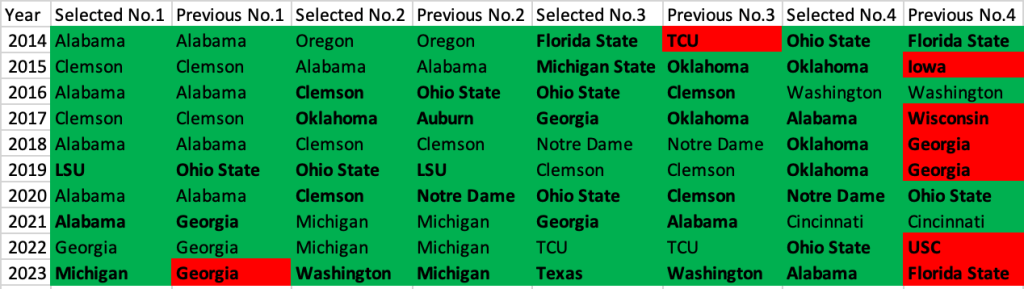
In 6 of the 10 years, the team entering the week as the 4th team ended up falling out of the playoff, and the other four ended up getting in. Alabama and Ohio State got in each on two occasions after being ranked at 5 the week before. Oklahoma got in from being ranked at 5 in 2018, and 6 in 2019, and until 2023, nobody below 6 had reached the final four until Alabama took down Georgia. The two biggest fallouts were by SEC teams, with Auburn falling from 2 to 7 in 2017, and Georgia falling from 1 to 6 in 2023 after losing the SEC Championship. For fun’s sake, both 2014 TCU and 2023 Georgia finished ranked 6 and thrashed their opponents by allowing just 3 points in their New Year’s Six game.
This is why the games are played, despite working against TCU in 2014, and Florida State to end the 2023 season.
 College Football Prediction Central with Paul Shen
You must be logged in to post a comment.