The 2023 College Football Season is finally in the books, and with it we say goodbye to the 4-team college football playoff format. As a graduate of the University of Michigan, I am incredibly happy with how this season went. Perhaps that’s an understatement, but the expectation was to get the national championship and the team got it done. With the sun now already set on the 2023 season, we also say goodbye to Nick Saban, one of the legends of the sport. While a national championship is always special, my emotional high on this season was Michigan’s victory over Alabama in the Rose Bowl to advance to the championship game. Michigan had to have their best game on New Year’s day and they had just enough to get past the Tide, despite a wild rollercoaster of a game in the Granddaddy of them all.
Happiness aside, this season was also very chaotic from the get-go, as Jim Harbaugh was suspended not just for the first three games of the season, but later again for the last three games of the regular season, and it says a lot about the coaches on Michigan’s staff, particularly offensive coordinator Sherrone Moore. He showed over four games that he has the skills and persona necessary to be a head coach at a major FBS program.
Perhaps the biggest story of all was the sign-stealing scandal that centered around Michigan and former staffer Connor Stalions initially. The Big Ten suspended Jim Harbaugh for the three game stretch to close out November, with wins ultimately over 2 top-10 teams in Penn State and Ohio State, and a pesky Maryland team. While the facts and investigation from an NCAA standpoint are still ongoing, it was clear that Michigan wasn’t the same team without Jim Harbaugh, as the three conference games without him were decided by 7.3 PPG on average, and the non-conference games were decided by 26.7 PPG on average. Rumors have it that Michigan is not the only one that steals signs, or attempts to steal signs, but also that an individual tied to Ohio State coach Ryan Day broke the news regarding sign-stealing. Prior to the playoff too, a video sharing tool that was widely used at the FBS level was avoided by the Alabama program in advance of preparing for Michigan, even though there was no breach. It remains to be seen how it will impact Michigan, and more notably, Jim Harbaugh’s future. I hold the belief that the punishment on this scandal from the NCAA will be the key contributor to whether Harbaugh stays at Michigan or leaves, but I believe too that Harbaugh will have to make that decision without all the facts at his disposal. I think Harbaugh leaves Michigan if, say, the punishment is handed down sooner, and it is a suspension of more than 4 games. I don’t believe, based on these circumstances, a suspended coach can do any activities to help the team, so if Harbaugh were to be out for an extended amount of time, he’ll essentially be out of work for that same time and it would be difficult to not part ways knowing he can’t contribute. On the other hand, the memories of the Rose Bowl and national championship games will never be taken away, even if the wins end up being vacated. As a fan, of course, I hope they are not.
The season itself had plenty of topsy-turvy moments too, from Sam Hartman’s debut in Week 0 all the way to the championship game. Before the season, USC, UCLA, Oregon, and Washington had agreed to leave the Pac-12 for the Big Ten. In between, Texas took down Alabama in Tuscaloosa, a place the Tide almost never lose, and Texas’ lone regular season loss later one was an epic Red River Rivalry battle in both Texas and Oklahoma’s swan-song battle as members of the Big 12 (it was announced in 2022 that Texas and Oklahoma would leave for the SEC and start the 2024 season as SEC members).
Colorado had a dream start to the season with an upset of TCU, though the Coach Prime hype train crashed by the middle of the season. Oregon and Washington played arguably the game of the year in week 7, with Washington outlasting them by a field goal in a preview of two teams on their way to the Big Ten. Dan Lanning and Kalen DeBoer appear ready for the action, though they’ll have to say goodbye to their veteran quarterbacks. Just kidding! Kalen DeBoer is on his way to the SEC and succeeded Nick Saban at Alabama.
TCU made the CFP in 2022 and only went 5-7 the next season including the loss in week 1 to Deion Sanders’ Colorado team. Each of 2022’s CFP semifinalists aside from TCU won their first 11 games of the season. Let that sink in. However, looking later, it is less of a surprise since Sonny Dykes’ last head coaching job at California maxed out at 8 wins and decreased with each passing year. Additionally, in 2023, three teams had 11-game winning streaks, and Texas’ win streak entering the CFP was 7 games.
The sign-stealing scandal first leaked on October 18, 2023, a few days before Michigan traveled to East Lansing to take on the Michigan State Spartans. Mel Tucker was fired earlier in the year for cause, after he had been accused of sexually assaulting / harassing Brenda Tracy. From a wins and losses standpoint, both Tucker and the interim coach Harlon Barnett each won 2 games.
The clarifying point about the sign-stealing was the method in which it was done, and whether there was knowledge by coach Harbaugh / others. Connor Stalions, a Michigan staffer whom ended up resigning a few weeks later, was the mastermind, having others go to games and also to record footage in advance as opposed to trying to figure out someone’s signs in-game. Recently, Stalions has continued to passionately support Michigan football. Good for him on that and staying true to his love for Michigan, but his true colors are out. Luckily, Michigan was able to continue their success without him, even though it was different in terms of the margin of victory, on average (> 20 PPG with, 14 PPG after). In six games without Connor Stalions, Michigan won against four top-10 teams. For what it’s worth, they only won against three such teams with him (Ohio State ’21, ’22, Penn State ’22).
The anticipation of the continued fallout from this sign-stealing was what discipline would come, and how long it would take. From an NCAA standpoint, investigations and any possible discipline is still ongoing, but Big Ten commissioner Tony Pettiti decided to move swiftly and suspend Harbaugh for the last three games of the regular season. More fallout included how teams prepped for Michigan, or how Michigan prepped for others, as Michigan was also on the other end despite being the main school implicated in the scandal. Again, there was a film-sharing portal that former Alabama coach Nick Saban advised his team to stop using as well. Luckily for Michigan, they proved that they could still be as good, if not better, of a team, as they beat Ohio State, won the Big Ten, beat Alabama in the Rose Bowl, and won the national championship game to cap an undefeated season.
Before continuing on my thoughts of the playoff, I think it’s important to also point out the craziest ending of the entire season was between Georgia Tech and Miami, where Miami had a chance to kneel down to run out the clock since Georgia Tech was out of timeouts. But Miami, inexplicably, was handing the ball off, and ultimately fumbled the ball to Georgia Tech. Georgia Tech quarterback Haynes King ended up throwing the game winning touchdown pass with 1 second left.
The best turnaround in 2023 to me was that of the Northwestern Wildcats. The year before, they only won their first game of the year, and lost 12 straight games after (including the 2023 season opener to Rutgers), and that win was not on American soil either. They also fired Pat Fitzgerald in the summer amid allegations of hazing in the program, and while investigations on this are also ongoing, David Braun, who had been hired as the defensive coordinator, took on the interim head coach duties, and led the team to an 8-5 season with a bowl win over Utah before being named the permanent head coach.
The end of the season stirred enough drama in and of itself, as Alabama had to fight for its playoff fate ever since losing in Week 2 to Texas. Having won 9 straight games since then, they traveled to Jordan-Hare stadium in Auburn to play the Iron Bowl and by this time they had actually already sealed the SEC West. With more to play for, Alabama couldn’t sleepwalk in this game, and wildly enough, they almost did. Auburn led most of the game up until the end with the score at Auburn leading 24-20, and Alabama quarterback Jalen Milroe had a nightmare sequence. He mishandled a snap from center on second down and goal, and then inexplicably tried to throw a pass after passing the line of scrimmage on third down, losing additional yards and having a long play for 4th and goal. To be exact, they had to get 31 yards in one play to keep their playoff hopes alive. The name is BOND, fellas. James, erm, Isaiah Bond caught the game winning touchdown to beat Auburn on 4th and goal from the 31, and they set up a date with Georgia in the SEC Championship the following week with national championship hopes at stake.
Entering the conference championship weekend, there were four undefeated power 5 conference teams, and it seemed like it was rather easy to decide who the top four teams would be. However, it did not play out as such because Georgia lost to Alabama. As such there were only three undefeated power 5 champions instead of four, and one of many questions before the reveal is whether Texas and Alabama did enough to jump into the top four with their wins. All season long, the head-to-head win for Texas held enough weight to keep Alabama below them, and a remaining question was whether Florida State did what it could to secure a spot as an undefeated power 5 conference champion. Another remaining question would have been who was going to get the Group of 5 spot in a New Year’s Six game, with Tulane being the top dog for that spot entering the championship games. However, Tulane fell to SMU so Tulane was out of contention.
Keep in mind that entering that week, Georgia was ranked at 1, Michigan at 2, Washington at 3, Florida State at 4. Oregon was ranked at 5 ahead of Alabama and Texas as well, with Ohio State being idle at 6 ahead of the Tide and Horns too. Alabama (8) and Texas (7) both won their conference championship games, along with Michigan, Florida State, and Washington, and prior to the final reveal, no team had jumped up from below 6th place to get into the playoff on selection day. It remained to be seen whether that would remain as the status quo, or if there would be new precedent set in the last year of the 4-team playoff.
Alabama defeated Georgia by a 27-24 score, and Washington defeated Oregon by the same margin, along with Texas winning by 28 points against Oklahoma State. Michigan, Washington, and Florida State all won as well, so there was quite a conglomerate of worthy teams on selection day, as 7 teams had 1 loss or fewer. Because Oregon lost for a second time, they were eliminated, even though they only lost to one team the entire season (Imagine if the were at 12 teams this year instead of four!)
With that in mind, 7 teams remained for four spots, with Ohio State being the least good of the teams at 11-1 and not having played a conference championship game. The night before the reveal, I described what I thought the final four would be and the process of elimination that I expected would happen. As 8 teams had 1 loss or less heading into conference championship weekend, Oregon was the first domino to fall. Ohio State was likely next because they didn’t play among the top 8 teams that weekend. Similar to what was described in the actual reveal, the 6 teams in play were the same 6 teams I thought would remain in that process of elimination. In that process of elimination, I stressed head-to-head most heavily, as the following head-to-head match-ups had taken place: Texas over Alabama, Alabama over Georgia. The transitive property in geometry indicated to me that Georgia, despite being ranked no.1 before losing the championship game, was worse than both 12-1 Texas and 12-1 Alabama, as Texas was already suggested to be better than Alabama. This ended up being how the committee saw it too as Georgia was ranked 6 and Ohio State and Oregon were ranked 7 and 8 in the final reveal. While inevitable, I thought it was unfair to see Oregon fall three spots even though they only lost to one team the entire year, but it was difficult to place a 1-loss Georgia behind a two-loss Oregon team. It would have been interesting if Oregon only fell 1 spot instead of three, to see what it would have done to the rest of the reveal.
It seemed obvious that the top 2 teams would be Michigan and Washington, and while the committee revealed the 3rd team to be Texas before showing Georgia was 6th, I knew that Texas, Alabama, Florida State, and Georgia were in play for the last two spots, and among these four teams, I knew Georgia was on the outside looking in additionally because they are being compared to three power 5 conference champions, including an undefeated power 5 champion. Unlike 2021, they couldn’t be deemed unequivocally better than, in 2023, two teams that transitively beat them head-to-head (In 2021, they were unequivocally better than two Power 5 conference champions despite losing the SEC title game to finish 12-1 because both Baylor and Utah both had 2+ losses).
With Georgia eliminated, it was really down to Texas, Alabama, and Florida State in some order. Another lingering question is whether Florida State, who won the ACC championship game 16-6 and was down to their third quarterback in the game, was still as good with who they had left compared to Texas and Alabama, who were virtually at full strength heading into the playoff. Being at full strength in the College Football Playoff is paramount with the committee indicating who the best 4 teams are since there are so many teams in college football that don’t play each other for generations.
Because the third ranked team was revealed to be Texas, and knowing Georgia later was revealed to be 6th after falling from the top spot, 4 and 5 were going to be Alabama and Florida State respectively, or Florida State and Alabama, respectively. In my process of elimination, I thought Florida State had done what it needed to to get in despite not having Jordan Travis, and be the third ranked team instead of Texas. All along, Florida State was ranked at least three spots ahead of Alabama in the CFP rankings, and as such I find it hard to imagine that Alabama as a 12-1 power 5 conference champion was suddenly better than a 13-0 conference champion from another power 5 conference. So in my opinion, I thought putting in FSU would have made the decision that much easier since Texas already beat Alabama head-to-head. Again, with the 3rd team being Texas, much to my surprise, I was likely going to be wrong that Alabama was going to be left out. In 2022, Alabama was the first team out as well, and while it is supposedly irrelevant, I retroactively couldn’t imagine two years in a row that Alabama was the first team out of the playoff, especially the second of those two years Alabama was a 12-1 SEC champion. (Despite a different set of circumstances as Georgia was 11-2 both years, Georgia was that first team out in both 2018 and 2019).
Having said all of that, Alabama was revealed as the fourth team, which led me to be shocked like many of us were, especially outside of the state of Alabama. ESPN’s Rece Davis indicated in the reveal program that two new precedents were set: Georgia was the first team to be ranked no.1 in the penultimate rankings and miss the playoff, and Florida State was the first undefeated power 5 conference champion to be left out. This second one was the more alarming of them, and I didn’t understand it then, but later on it made sense.
Kirk Herbstreit made a key point on the CFP reveal program that Alabama and Florida State were being compared, on the final day, with respect to the “current team and roster (3:16)”. For Alabama, they had their full complement of players and Florida State didn’t. As a result, despite it being unfair, with who Florida State had left, they only really had three games to evaluate Florida State but 12 games to evaluate Alabama because Jalen Milroe played 12 games including a conference championship game. Brock Glenn did not look the part for Florida State that Jalen Milroe was for Alabama, and based on the games being compared with the “current team and roster”, Florida State was much worse offensively than Alabama is, despite both of them being elite defensively. That seems like it was enough of the difference that put Alabama ahead of Florida State even though the Seminoles were undefeated and Alabama wasn’t. Joey Galloway on the same program said that Texas could lose Xavier Worthy and still be as loaded because the QB position is that important, and the same could be said about JJ McCarthy and Michael Penix for Michigan and Washington, and it was clear that the teams went as the quarterbacks went especially with respect to the offense, and that was something Florida State lacked compared to the teams that got in. I believe this is the same summarization that committee chair Boo Corrigan gave, and credit needs to be given to Boo as well because he’s an ACC AD (NC State), and perhaps he had to put ACC biases aside. Additionally, enough people in the committee room saw what I ended up understanding as more time passed post-reveal.
In the same post about the process of elimination, I mentioned that I thought where the teams were ranked should come into play. However, that is actually just a footnote. In essence, the teams are re-ranked based on how they played with the most recent week now being considered along with the rest of the body of work, and while the rankings change less week-to-week if the higher ranked teams win, this way the games do matter along with the fact that injuries are also considered if a team has them.
This also partially changed my thought that the CFP needed to be expanded, as I had become OK with the CFP being kept at four teams. As we look ahead to the 12-team format starting next season, I tried to get Kirk Herbstreit and Chris Fowler’s attention about the following patterns regarding the 4-team CFP semifinals over the 10 years they existed:
- The 4-seed was the only one never to win the Rose Bowl as a playoff semifinal. (The 1-seeds that won the Rose Bowl were 2-0 in the championship game.)
- The 1-seed was the only one never to win the Sugar Bowl as a playoff semifinal. (In fact, the lower-numbered seed was 3-1 in the Sugar Bowl and only the 4-seeds that won the Sugar Bowl went on to win the national championship.)
- The odd-numbered seeds were 3-0 in the Orange Bowl as a playoff semifinal. (The 1-seed was 0-2 in the championship game and the 3-seed was 1-0 in the championship game.)
- The higher-numbered seeds were 3-0 in the Cotton Bowl as a playoff semifinal. (The 2-seed was 2-0 in the championship game while the 1-seed was 0-1.)
- The Fiesta Bowl never had the 1 vs. 4 matchup in the CFP semifinals. (The 3-seed was 2-1 against the 2-seed and when the 3-seed won the semifinal, it lost the championship game. The 2-seed that won was Clemson in 2016 and went on to win the championship game.)
- The Peach Bowl never had the 2 vs. 3 matchup in the CFP semifinals. (The 1-seed was 3-0 in the Peach Bowl against the 4-seed and was 2-1 in the championship game (the loser was 2016 Alabama), and each winner in the Peach Bowl as a semifinal was the SEC champion that season.)
Additional details are as follows:
- Clemson is one of three schools to win a CFP game at the same semifinal site twice (the others are Ohio State at the Sugar Bowl and Alabama at the Cotton Bowl). Alabama has appeared in and won at four of the New Years Six games twice as CFP semifinals as well, going 1-1 at the Rose Bowl, 1-1 at the Sugar Bowl. Ohio State has appeared in two semifinal sites, going 2-0 at the Sugar Bowl but 0-2 in the Fiesta Bowl. Georgia has won semifinal games at three of the New Year’s Six games as well.
- Two schools can stake the claim that they’ve played in every New Year’s Six stadium at least once (Alabama, Ohio State), and two more schools (Oklahoma, Penn State) can match the claim that they’ve played in five of the New Year’s Six games during the CFP era. Oklahoma and Alabama have never played in the Fiesta Bowl and Ohio State and Penn State haven’t been to the Orange Bowl. Both Alabama and Ohio State have appeared in championship games at the New Year’s Six game they haven’t played. Clemson and Michigan have both played in four of the six, where Clemson hasn’t been to the Rose or Peach bowl, and Michigan hasn’t been to the Cotton or Sugar Bowl games.
- Georgia is the only school that never lost a CFP semifinal game after appearing in the CFP multiple times.
In the 10 years leading up to the decision to expand from 4 to 12 teams starting in the 2024 season, I imagine there were other numbers of teams considered, such as 6, or 8. I would love to vouch for 48 teams if we’re going to make the bowl season matter though, as college football, to me, would be better if every school had the opportunity to get funding for its school to make their programs better. It is a privilege to be able to have football as a varsity sport and to make big money with it, as the 130 schools at the FBS level are best equipped to handle the finances of it. Bowl games and their sponsors give payouts to the teams that play their bowl games, where even if a team went 0-12, I’d imagine it deserves the same opportunity as the team that wins the national championship to try to develop its program to be better. Recruiting will naturally be top-heavy for the best schools, but by having a 48-team playoff, the intent is to keep bowl season as it is and let every school play a 13th game and have the 15 practices between the end of the season and bowl season to allow players to have reps that they otherwise wouldn’t get.
As far as the CFP stands right now, I’m surprised that 5 teams perhaps wasn’t considered at any point. The MLB had a 5-team playoff in each league where the last team was a wild card team that had to fight to advance to the divisional series in either a one-game or best-of-three game series for many years. As of 2022 or so, MLB included an additional team so it is six teams, and if we were to apply that to college football, it would have been interesting to see how the games fared with 5 or 6 teams. With more than 4 teams, there are 3+ rounds, and perhaps that was a challenge for logistics reasons.
If five teams were the CFP selection instead of four:
2014 – 4) Ohio State vs. 5) Baylor, winner plays 1) Alabama
2015 – 4) Oklahoma vs. 5) Iowa, winner plays 1) Clemson
2016 – 4) Washington vs. 5) Penn State, winner plays 1) Alabama
2017 – 4) Alabama vs. 5) Ohio State, winner plays 1) Clemson
2018 – 4) Oklahoma vs. 5) Georgia, winner plays 1) Alabama
2019 – 4) Oklahoma vs. 5) Georgia, winner plays 1) LSU
2020 – 4) Notre Dame vs. 5) Texas A&M, winner plays 1) Alabama
2021 – 4) Cincinnati vs. 5) Notre Dame, winner plays 1) Alabama
2022 – 4) Ohio State vs. 5) Alabama, winner plays 1) Georgia
2023 – 4) Alabama vs. 5) Florida State, winner plays 1) Michigan
While Florida State got pummeled 63-3 vs. Georgia in the 2023 Orange Bowl, I think it has to be taken with a grain of salt since FSU’s defense had an unprecedented number of opt-outs. Even so, I think Alabama vs. Florida State would have been the most lopsided among these 4 vs. 5 matchups had it been 5 teams because of who Florida State was missing on offense. For what it is worth, the 4-seed was only 2-8 in the CFP semifinals, which is the worst among the CFP seeds. The 3-seed won half the time against the 2-seed, so the 3 vs. 2 is essentially a coin flip.
If there were six teams, the following 3 vs. 6 matchups would have taken place:
2014 – 3) Florida State vs. 6) TCU, winner plays 2) Oregon
2015 – 3) Michigan State vs. 6) Stanford, winner plays 2) Alabama
2016 – 3) Ohio State vs. 6) Michigan, winner plays 2) Clemson
2017 – 3) Georgia vs. 6) Wisconsin, winner plays 2) Oklahoma
2018 – 3) Notre Dame vs. 6) Ohio State, winner plays 2) Clemson
2019 – 3) Clemson vs. 6) Oregon, winner plays 2) Ohio State
2020 – 3) Ohio State vs. 6) Oklahoma, winner plays 2) Clemson
2021 – 3) Georgia vs. 6) Ohio State, winner plays 2) Michigan
2022 – 3) TCU vs. 6) Tennessee, winner plays 2) Michigan
2023 – 3) Texas vs. 6) Georgia, winner plays 2) Washington
These 3 vs. 6 matchups would have been quite intriguing to me, so perhaps there was a missed opportunity with 6 teams at some point between 2014 and now before moving to 12 teams. I believe there was a notable drop-off between the 6th and 7th team because the 7th ranked team was 3-7 in their bowl game, and the 6th ranked team was 9-1. The 6th ranked team was 2-0 against the 7th ranked team in that time during bowl season as well, winning by a combined 52 points. Additionally, the 6th ranked team was 2-0 against the 5th ranked team, winning by a combined 89 points as well, where the 5th ranked team was 4-6 in bowl season in the 10 years of the 4-team format. Having that in mind, 4 is reasonable, and both 5 and 6 would have been reasonable too.
While we reminisce about what the best number would be, I additionally wonder why a 4-team round robin or 4-team double elimination wasn’t considered. Double elimination would have worked as such that there is a winner’s bracket and elimination bracket, where you get placed into the elimination bracket if you lose your first game. Using the 2023 playoff as an example, Alabama would have played Texas in an elimination game and the winner would face the loser of what we saw as the national championship game between Michigan and Washington, so the team that won twice (Michigan) would have to lose twice to lose the championship, making the max number of possible games at 7, with at least six total games being played. Because Washington lost that championship game, in the round robin, The winner of the elimination game has to play another elimination game against the loser of the winner’s bracket to determine who the last two teams are (see below).
- Michigan over Alabama and Washington over Texas
- Michigan vs. Washington and then Alabama vs. Texas
- Michigan is safe from elimination and Washington faces the winner of Alabama vs. Texas
- Winner of Washington vs. (winner of Alabama vs. Texas) meets Michigan and has to beat Michigan twice to win the championship. If Michigan wins once, they are the champion
Round Robin to me could be pretty straightforward too, as every team plays the other, and the team with the best record wins the championship. However, it is possible to get dicey if a scenario happens such that multiple teams have the same record at the top after playing all three teams, as head-to-head would be one of multiple tiebreakers (similar to soccer). If a team went 3-0 against the rest though, that team would be the champion.
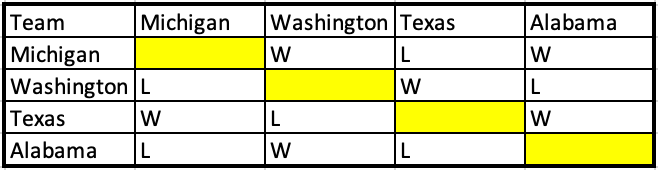
Notice that in this hypothetical, I’m imagining that Texas won again over Alabama, and Alabama beat Washington, and Texas then beat Michigan after losing to Washington. With Michigan and Texas both 2-1, head to head favors Texas so Texas would be the champion. If all else held constant and Texas lost to Michigan instead, then Michigan would have been 3-0 and won the title (It is possible for three teams to be 2-1 and the other be 0-3 as well). The yellow boxes represent a team against itself which should not happen.
While the 12-team model is already set, I think it would have additionally been interesting if each of the 12 teams was the winner of the conferences in college football. This would give more exposure to the non-power 5 conferences beyond what we will see starting in the 2024 season, and would be much more similar to the NFL playoffs. The difference between the college football and NFL playoffs as of 2024 are that divisions and conferences are much more drawn out in the NFL. If the 12-team model had the winners of all the conferences instead of just the top 11 teams + top group of 5 team, every conference is competing similar to the way the NFL playoffs have it (the NFL has 2 conferences). While it may impact the competition on the field, exposure is also important especially in the NIL era we are in now. In my opinion, as NIL continues to expand, it is dangerous if it only expands at the top of the game, because it is natural for the top programs to have more funds available to divest into NIL.
As exciting as it is for Michigan to be Rose Bowl champions and National Champions, I am also excited for what the future holds (hopefully more playoff appearances and championships!), though many top contributors have officially departed for their NFL preparations and will be sorely missed as Team 145 gets ready for the first year of the expanded Big Ten. Michigan will get to play Washington again as well, even though both teams suffer notable losses especially on offense. Because of the impasse between Jim Harbaugh and both NFL teams and Michigan, it is again possible he will be gone as well. I will never forget this dream season even though the Rose Bowl is my favorite memory of them all. It got a major monkey off the back of the Michigan team and Michigan made the most of its third opportunity to capture a national championship by coming home with the hardware.
After the national championship game concluded, I finished my predictions with a 661-236 record (.737) after picking just 23 of the 42 postseason games correctly. This is a nearly full percentage point drop after conference championship weekend, and despite this, I’m again really happy about how Michigan fared despite its past failures in the postseason.
Thank you all for reading my posts this season, and I will see you all next season. To my Michigan brethren / family, who’s got it better than us?
 College Football Prediction Central with Paul Shen
Comments
One response to “Parting Thoughts on the 2023 College Football Season + Final Predictions Performance”
[…] of today’s landscape along with the lack of non-power-5 representation. I mentioned in my 2023 season farewell post that the NFL model would be more equal to all the conferences at the FBS level as the NFL model has […]
LikeLike